The soil drinks deep of long-awaited rain. Gnomes are fleeing from their flooded burrows.
The beach is closed for fecal matters, try again tomorrow. The Kraken feeds.
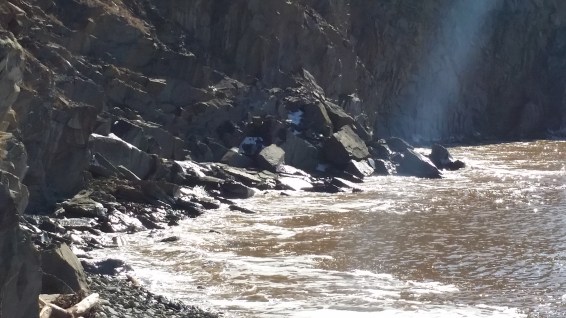
Reflections quiver and shimmer on the rock wall rising from the creek. A sylph’s breath upon stone.
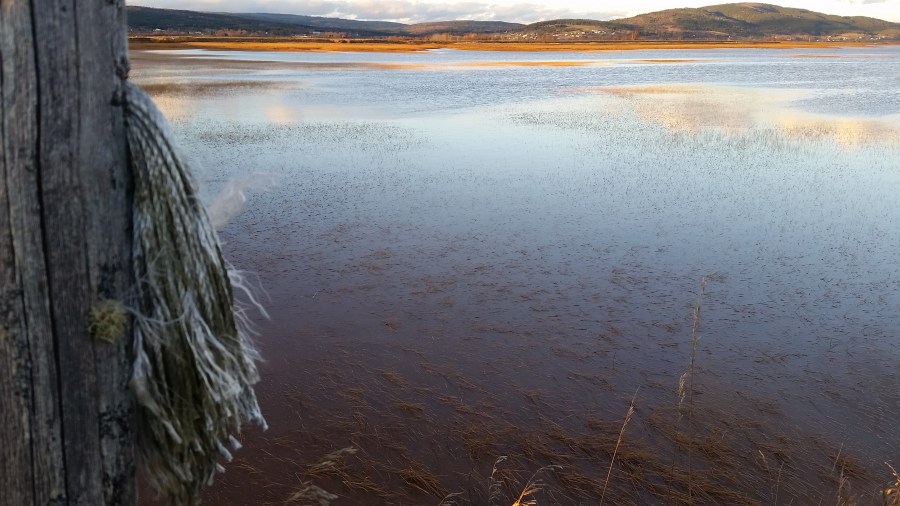
A toxic algae flourishes in the depth of a lake. The lake demon grins and whispers “my garden is blooming.”
The humidity will be high this week and Environment Canada has issued heat warnings. The waterlogged ghosts of drowned people are expected to crowd the living this week. You have been warned.
It’s been hot and humid on the mountain these past few weeks, making it hard to sleep. Sleeplessness has a strange, twisty effect on my imagination. The above lines are my muddled responses to things I saw or heard on the news. Future stories, perhaps, but the water theme tempted me to gather them together.
In writing news, the editor/publisher of the children’s bedtime story anthology Eeny Meeny Miney Mo: Tales for Tired Tykes sent me this review of the book, mentioning that my piece, Leif the Story Hunter, was their favorite. That gave me a thrill.
Print copies of the book are now for sale on the Patchwork Raven’s website for $65 (NZ, international shipping included). My print copy hasn’t arrived yet but I am watching for it.
The rocks held back. The sand shivered and lay still, hoping it wouldn’t be noticed.
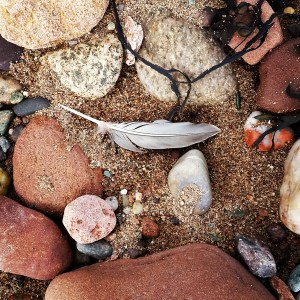
A child toddled along, craving seaside treasure. Seeing the feather she grasped it and up and up she flew, soaring over islands, bays, and oceans, till she landed by the phoenix’s side.
The phoenix wondered what this could mean. Why had his human love sent a child in her stead? Could it be … his? But nay, such things aren’t possible. Are they?
“Bird,” said the child. “Fire.”
The phoenix nodded and sent the child home with fire. A fool’s gift to one too young to fear it.
Her village burned, till the waves came up and doused it, gathering the child and pulling her into the sea. Fascinated by the sky it could smell on her skin.
There it kept her, safe from flames. She walked the seabed a smouldering ember, her head above water. Not sky, not sea, not earth, not flame.
Not happy.
The embers of her skin cracked as she grew, dividing into plates. Toughening with endless callouses and turning green with algae. Her eyes brightened with inner flame and her pupils lengthened into slits. Webbing grew beneath her arms as the talisman of flight twisted them to wings.
She flapped the wings and left the sea, fire roiling in her belly. The dragon soared across the sky. She left the talisman behind, free.
Frightened waves hurried the feather to shore and dared not touch it again.
The rocks held back. The sand shivered and lay still, hoping it wouldn’t be noticed.
A child toddled along, looking for seaside treasure.
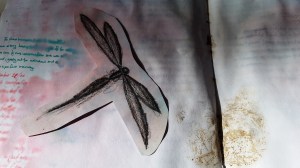
Glue dissolved, but the charcoal sketches held fast in the book’s embrace. Now they gather dots of mildew like age spots on the hands of couple growing old together.
The pain of losing them is gone now and the lost stories shift into myth. I think I like them best this way, though I’ve switched to waterproof ink.
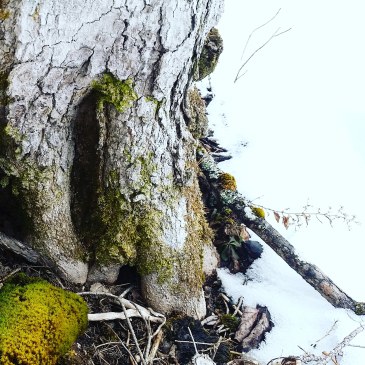
Stumps rot away into miniature castles, old galls whisper of dark magics, and scars turn into doorways at the base of a tree. These doorways captivate me. Tucked away yet plentiful, turning entire forests into magic hidden villages.
If I knock, will someone answer? Who are they? How do they live their lives? Their stories weave themselves in and around my imagination.
If I don’t knock, if I just step inside, will I find myself outside of time? Will the world be changed around me? Will I be different when I return? Will you know me? Will you notice it in my eyes, in the way I wear my hair?
But then again, I couldn’t. I couldn’t walk inside without a knock, catching some poor dryad mid-shower, shocked and reaching for a towel.
Come on, then, knock. Let’s go.
I hesitate. If I don’t knock, the stories rule the day. If I do knock, then my imagination is limited to what it finds. My knuckles tingle. I shove them in my pocket and move on. My children need me. I need them. Mothers must tread careful with the risk of getting whisked away to other worlds. I’m hunting stories, not adventure. For now.
I’ve noticed a lot of discouraged writers of late. Is it something in the season? The air? The non-existent water levels in the moon’s Sea of Tranquility? Maybe it’s a symptom of a craft that calls for constant effort. I’m not immune, though if there’s a vaccine that works against discouragement infections, I’m in (take note, mad scientists), as long as I don’t have to give up those moments of thrilling encouragement.
One writer, in particular, is a fellow whose blog and writing I’ve been following for a few years. J. S. Pailly’s work at Planet Pailly is fascinating: his fiction, his informative science posts, his wicked illustrations, and especially his dedication. I learn so much, and with so much wonder, that it feels like a clever magic system. But it’s not. It’s actual science *gasp*. Thing is, James has been discouraged of late, and he’s writing about it. He recently posted this stunning graphic which details a journey which all of us find ourselves on at some point. Clicking on these oddly colored lines will take you right there to behold its wonder for yourself.
If James can discouraged, with his amazing blog, loyal band of merry followers, and mind full of wonder, what chance do the rest of us stand??
I’ve started collecting things. Encouraging things. Things I can stuff away in a file and pull them back out when I need them. It isn’t a big file, not yet, but it has begun. James’ illustration is in there, and so are these:
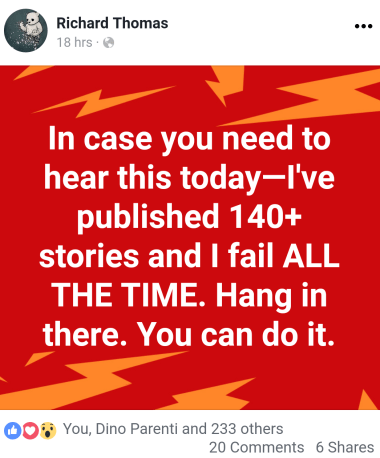
Another writer I admire (enough to take a course from), Richard Thomas, posted this quick, thoughtful note on facebook
It’s good to get a solid dose of perspective now and then.
I have a small review I received once upon a time which delighted me and first inspired my anti-discouragement file. This review showed up in a black time and has gone a long way to helping me pick myself up after I crash hard.
When I read it, I remember “Making a reader feel this way is why I do this. This is mine to keep. I earned it. Now I just have to keep going” … even when I feel like Sisyphus pushing a big story rock up Mount Publication.
Keep track of the good stuff so it’s there when you need it. We all get discouraged, even our heroes. Remember that. Keep writing.
How do you combat discouragement? Are you a mad scientist looking to create a discouragement inoculation and need some volunteers? Comment below and maybe we can help another writer out.
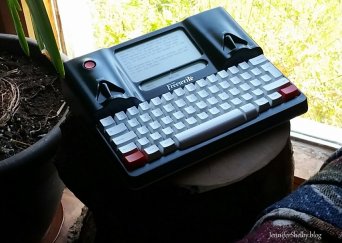
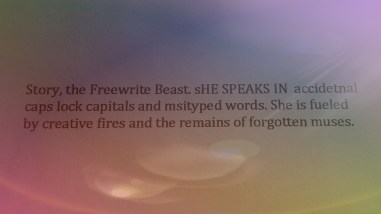
There’s a friendliness to this little beast, perhaps in the face I see when I’m writing, folder and wifi toggles like eyes, the keyboard a toothy grin. It reminds me of the way I imagined helpful robots in the era of Return of the Jedi and Flight of the Navigator. Or maybe my old Speak ‘n Spell?
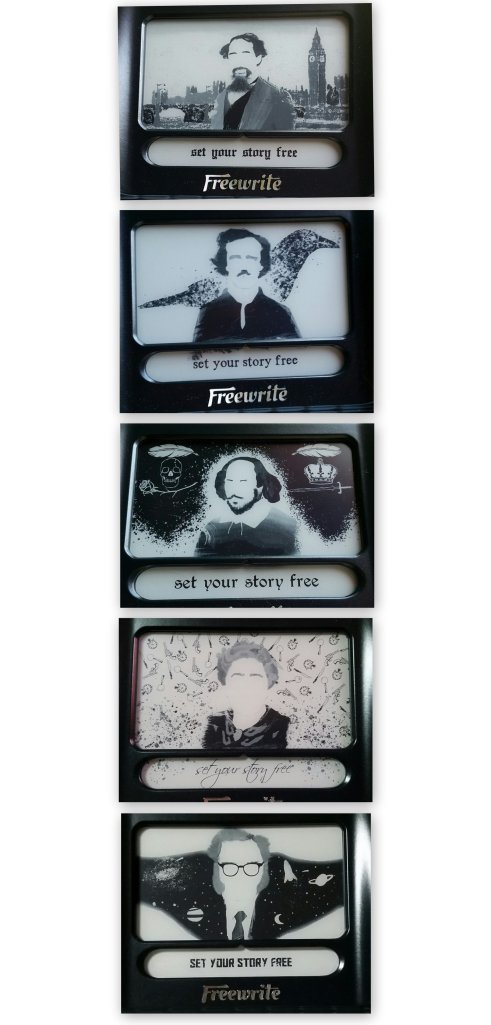
Depictions of familiar writers wait for me before I turn it on. Isaac Asimov, Agatha Christie, William Shakespeare, Charles Dickens, and Edgar Allan Poe. “Good morning, Chuck,” I catch myself saying to Charles Dickens as I set down my coffee and turn it on. His face disappears and my writing awaits.
While I admire these great writers, I’d love to see writers of color represented, as well as a better balance of genders. Alexandre Dumas, Toni Morrison, Maya Angelou – they would do well in this crowd.
Technically speaking, the Freewrite keyboard is smaller than my laptop keyboard, which took me a moment to adjust to. It does bring to mind happy memories of plunking away on my parent’s electric typewriter, dreaming of being a famous novelist like the fictional Jessica Fletcher (obviously the whole mystery writer thing didn’t take). The notable exceptions being that the Freewrite fits on my lap without crushing me and has all the convenience of digital processing.
Learning how to use my Freewrite was as simple as following a few prompts to set up my ‘Postbox’ online and sync my cloud.
I ran into some syncing problems early on and panicked, thinking I’d lost my work. Freewrite covered me by sending a .pdf and a .txt copy of the work in question, which I didn’t expect. Thanks for having my back, little Freewrite!
A quick trip into the troubleshooting forums instructed me on how to re-sync my cloud. I suspect my spotty satellite connection will make this fix a common event. In the forums I also discovered that I can also plug the Freewrite into my laptop with its USB cord (also used for charging) and access my work through my Postbox online. Backups of backups? Yes please!
The Freewrite does not allow for editing. This is strictly a first draft machine. It is a pleasure to draft on as I stare off into the distance, lost in the world of my story, no glaring screen demanding my attention.
My preferred method is writing long-hand, which gives me a feeling of intimacy with the page and the words as they come. I don’t get this with my laptop, but I am finding this personal ‘sweet spot’ on the Freewrite. It feels like a writing buddy, with all the familiarity of an old notebook, stuffed full of stories. Full disclosure: I’ve already named the device and given it a backstory. #wordnerd
The screen is a game changer for me. I often get eye strain after a long day in front of my laptop. With the Freewrite, I’m constantly looking up, at the baby, and across the room as I consider something new. While it’s not over-bright, I turned off the screen light first thing (hit the ‘special’ key + l), which is my personal preference, and discovered I can still read my work by regular lamplight at night.
As a bonus, I can see the screen just as well outside, which means I can move my writing outdoors without any trouble. The Freewrite feels sturdy enough that I’m not afraid of damaging anything internal by lugging it outside. Hellooooo hammock writing!
There are other features worth mentioning: the battery that lasts for a week; the word count option in the lower window (my favorite); and there’s even a timer option for word sprints!
that’s gonna come in handy for NaNoWriMotime your word sprints!
The slogan of the Freewrite claims it is a “distraction free writing” device. Astrohaus’ website promises it will double your productivity. Is this true? That’s the real question. These beasts don’t come cheap.
First: is it distraction free? The Freewrite is set up to write, and nothing else. The wifi capability works in one direction: to your cloud. You can’t google something, you can’t search thesaurus.com. You can’t even go back a few paragraphs to edit without deleting everything ahead of it. You are forced to slog ever onward.
I’ve read arguments that this is silly, after all, who doesn’t have a phone handy to look things up and fall down a rabbit hole of something or other? This made sense, so when I first pulled my Freewrite onto my lap, I left my phone across the room. The first time I reached a point where I would normally look something up, I looked at my phone, far away, remembered how comfy I was, how well the writing was going, and left it where it was. I could look it up later. I typed a note into my draft to remind myself, and kept on going. This happens about twice a day as I’m clickety clacking away, and I’m consistently choosing to keep writing. I am consciously making this choice, but the Freewrite removes temptation.
Productivity is trickier to prove. Eight months ago, before Baby Nim arrived, I was averaging 13 645 new words per month (not including any editing and secondary drafts). Since Nim arrived, I’ve been struggling to reach a measly 4000 new words per month. Yeah. Time to get back on track.
What I propose is to track my writing for the rest of September, on into October. I’ll stop when November arrives as I plan to participate in NaNoWriMo and this will skew the results. If there’s interest, I’ll consider posting the results of the months following November as well.
I’ll only track new words drafted on the Freewrite for the purposes of this experiment. Further skewing may come from the Freewrite being a new toy, but the lengths of the experiment should ease this skew and a pattern should emerge by the end of October.
There may be a tendency toward greater productivity because I’m being held accountable. We’ll have to absorb this one, I’m afraid, as I see no way around it. I can tell you that I’ve always found ways to hold myself accountable (waves sheaf of calendar records). I’ll come back here at the end of October and post my results.
At this point I have had my Freewrite for seven days. In this time I have written as follows:
Day 1 – 705 words
Day 2 – 2145 words
Day 3 – 1571 words
Day 4 – 1749 words
Day 5 – 239 words
Day 6 – 1724 words
Day 7 – 681 words
In the past week I’ve already surpassed my post-Nim monthly writing average, but will it last? Can the Freewrite actually double my pre-baby productivity? Let’s find out!
Issue 68 of Andromeda Spaceways is out today, which is especially exciting because it contains my short story Mrs. Coleman’s Backyard Refugee Camp. Just look at this gorgeous cover
artwork by Evgeniia Litovchenko
It is quite a thrill to see my name on there!
The digital issue is available for purchase on Andromeda Spaceways’ website for $4.95 (Australian dollars). I’d love to hear your thoughts if you read it!
On another note, my eldest starts kindergarten tomorrow. Which may mean more time to write, but first … inevitable heartache. *deep breath*
Paige strode across the sunny terrace to a bistro table set for two. Wisps of gauzy fabric whispered about her bare feet. She threw herself into a shaded chair with the petulance of a teenager whose been called a child. “What’s on the menu today? A cup of discouragement? A plate a self-loathing?”
Fear smiled, revealing his fangs. “Both, actually.” He served these dishes to her cold. “Enjoy your breakfast.”
She sipped at her cup in cheeky rebellion. It was all she had left and she refused to fight with him. “I must say, I couldn’t help but admire your work in the United States this week.”
Fear sat down in the chair opposite hers, crossing his legs and taking a nibble from her plate. “It’s almost too easy. The threat of nuclear war makes everything so deliciously tense.”
“Hmmm.”
Fear leaned forward, licking his lips. “What about you? How’s the writing going? Received any rejections of late?”
Paige shook her finger at him. “Naughty Fear. I haven’t even finished my breakfast yet.”
“Ah, then allow me to offer another dish: a bowl of ‘my accomplishments are all worthless’ stew. Full of all the things that eat you up on sleepless full moon nights.”
“How generous of you, darling Fear!” She watched him cringe at her ‘darling’.
“Now, Paige, be careful. You wouldn’t want to piss me off.” He snarled, his eyes flashing.
She leaned across the table, sweeping her cup of discouragement, her plate of self-loathing, and the stew to the hard-tiled terrace ground. They shattered with a satisfying smash. “Do your worst. You were always going to anyway.”
Drool began to ooze from his fangs. He always loved his victims best after they moved past the simpering, tearful stage. Paige held his gaze. She was growing stronger. He would make a writer of her yet.
I take a deep breath. “That’s a loaded question, pumpkin. Every writer has a different way of knowing, and I can only tell you my way.”
She looks frustrated. “But how do you know?”
“I know a story is done when I can read it out loud without tripping over any lines or feeling self-conscious.”
She stares at me, a perplexed look on her face. I struggle to explain myself. “It might sound simple, but it takes a lot of work to get there. First I revise it a few times on paper, then I start reading it out loud, pen in hand to mark the spots that need work. Sometimes I’ve gotten my plot tangled in my first revisions, so I have to do undo all of that.”
She continues to stare, the furrow in her brow growing deeper.
I start to sweat. “Sometimes I’m so embarrassed I want to burn it, so I put it away for the rest of the day. By the next morning I’m ready to tackle the broken spots and sculpt my story into what I want it to be.”
I chuckle. “These days this involves pen, paper, and a clipboard resting on the baby’s bottom while she contentedly suckles. When I’m done I’ll feel happy and exhilarated.”
“Exhilarated?”
“That means happy and alive. When I wake up the next day, I might read it again and realize how much work is left. One day I’ll read it and everything will fall into place, a story that flows as smooth as the baby’s bottom it was edited on, and then, at last, I’ll know it is done. At least until my critique group tells me otherwise, but that’s another thing altogether.”
She shakes her head. “No, mum, I mean, how do you know when its finished?”
I stare, drawing a blank. “I don’t understand.”
She stamps her foot. “How do you know when to stop reading?”






 Jennifer Shelby