Welcome to this week’s edition of Submit Your Stories Sunday! Every week I bring you a unique call for submissions to help you find a home for your stories or inspire a new one. Each call will contain a speculative element and will offer payment upon acceptance. Next, I’ll recommend a book to help inspire your story submission.
Cast of Wonders
Eligibility: Stories written for an audience of 12-17 years, filled with wonder and emotional resonance. High fantasy, science fiction, and horror are welcome providing they can no adult elements.
Take Note: Cast of Wonder is accepting both flash fiction and short stories during this submission window. Be aware that all submissions are anonymous and adjust your manuscript accordingly.
What makes this call stand out: Cast of Wonders offers pro rates to writers and give you the chance to hear your story read by a voice professional on their highly rated podcast
Payment: $0.06 per word, USD.
Submit by: the current submission window closes December 15th, 2018, but check their schedule in the link below for upcoming dates if you miss this one.
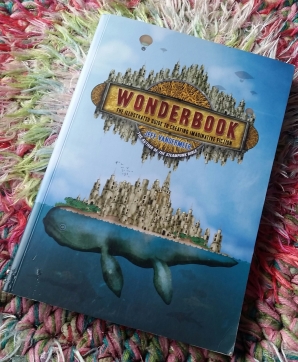
Jeff Vandermeer’s Wonderbook: the Illustrated Guide to Creating Imaginative Fiction is an art-rich extravaganza for the writer’s senses. Featuring essays and contributions from Neil Gaiman, the late Ursula K. Le Guin, Nnedi Okorafor, Catherynne M. Valente, and many more, there is something within these pages for every writer to learn.
My first attempt to read this book from cover to cover faltered, but keeping it on my bookshelf and dipping into chapters as I need guidance has given me much inspiration. For those who like to know exactly what they’re getting into, the chapter heading are as follows; Inspiration and the Creative Life, the Ecosystem of a Story, Beginnings and Endings, Narrative Design, Characterization, Worldbuilding, and Revision. Included are some of the wildest infographics I’ve seen yet.
This book mimics a university text, but it sets aside the dullness for feats of the imagination and pockets of real wonder. Find a copy, flip through it, and see if you don’t agree.
—
In writing news, I have a flash fiction story published in the latest Fantasy Files newsletter from Engen Books. You can read it for free here.
Welcome to this week’s edition of Submit Your Stories Sunday! Every week I bring you a unique call for submissions to help you find a home for your stories or inspire a new one. Each call will contain a speculative element and will offer payment upon acceptance.
Zizzle
UPDATE: It has come to my attention that as of January 2019, Zizzle is charging writers a $3 (U.S. dollars) submission fee. I have removed the link to their submissions page as this is not industry standard and writers should be extremely wary.
Eligibility: Zizzle is a middle-grade ‘bookzine’ seeking stories from 500 to 1200 words which will appeal to readers 10 and up, including adults.
Take Note: their submission says that submissions are “free until December 31st, 2018.” Does that mean they will charge for submissions in 2019? Not sure, but I’d recommend subbing before the new year to err on the side of caution.
What makes this call stand out: these hardcover print magazines are stunning, the pay is wonderful, and yahoo, its a new kidlit market!
Payment: $100 USD per story.
Submit by: ongoing submissions, but don’t miss the section above regarding December 31st.
What I’m Reading:
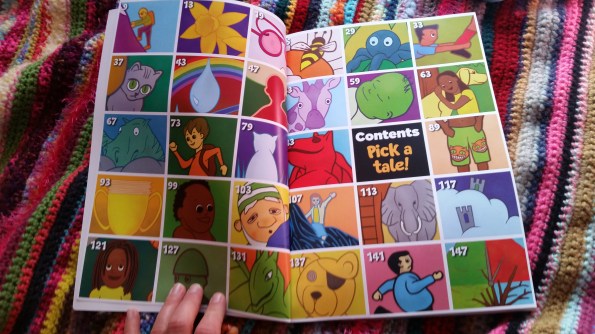
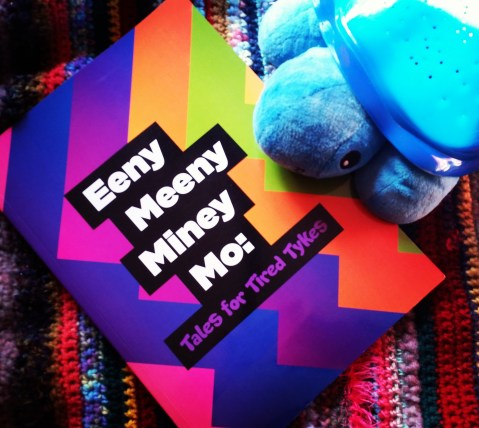
The kids and I have made our way through Eeny Meeny Miney Mo: Tales for Tired Tykes. It’s a fun book of bedtime stories. The girls love picking out the story by choosing a picture and little Nimia is delighted by the bold colors and simple lines of Jon Stubbington’s illustrations.
Table of Contents, with art by Jon Stubbington
Before I go deeper into my review, a caveat. There is a wide breadth of stories in here. There are sports stories, mindfulness tales, and many more, meant to appeal to a wide range of kids, but not necessarily to me. That bias will affect my reviews so I’m going to stick with the fantasy stories for my review, because that’s my wheelhouse. This is ten out of twenty-nine tales. Also, this review is intended for parents, so spoilers abound.
Lida’s Rainbow, by Ariel Stone, is the story of a land brown and cracked, without rain for a generation. The children, except for Lida, don’t believe in color anymore, for they’ve never seen any. After her father gives her a wishing stone, Lida makes her wish and awakens to a beautiful rain culminating in a breathtaking rainbow. This story left me with questions. Why no color anywhere? But the girls didn’t question it, they dug right in and delighted in the first drops falling on the roof and the vindication of the colorful rainbow.
The Boy Beneath the Beech Tree, by Edward Ahern, tells the tale of a terrible ogre who kidnaps a boy to do his chores for him while the boy’s Granny is away. With the help of a skunk, the boy is able to escape by locking up the ogre instead. After he hears the ogre moaning, the boy returns and releases the ogre after making him swear never to harm the boy or skunks again. I enjoyed this story very much, and I loved that the boy returned to the ogre rather than letting him die. I did worry this one might scare the girls, one of whom has endless nightmares about being kidnapped, so I read the ogre in the silliest voice I could come up with to tone down the suspense.. It worked.
Lady Ogress and Oglets, by Lyn Godfrey, follows the sole lady ogre in a village of ogres. After she finds a human baby in the forests, she conceals its humanity by coating it with a green face mask she makes for her complexion. The baby is noisy and fussy but cute and soon all the ogres want one. To satisfy demand, she travels to human orphanages and collects babies, coats them green, and delivers them. She keeps them green by sneaking in at night and giving them another coat. Of course, eventually she is caught, but all is well. The ogres have fallen in love with their babies. It’s a fun story., though I worried over how inclusive it was, despite its theme.
When Rivers Run Up, by Salena Casha, tells the story of an immature water-god dragon in a school for gods who unwittingly unleashes his water powers on a village and can’t shut them off. The villagers are in grave danger of being washed away forever until he uses his wits and fellow young gods’ help to tilt the world on its axis and save the village. Based on Chinese mythology, this is a wonderful story to use to teach kids about the way past generations saw the world.
Hector and the Moon Cat, by Daisy E. White, is the perfect story for kids plagued with nightmares. Hector notices a silver cat on his windowsill as he worries about dark dreams. The cat takes him on an adventure to the Moon Valley and explains that the moon cats collect bad dreams from children and hide them in the dark valley, where they can never return.
The Princess and the Dragon, by Wondra Vanian: Drewhilda’s parents worry that she will never marry and their kingdom will fall to her evil uncle. The feminist in me stopped and had a conversation with the girls about how women are more than capable of ruling before we carried on. Drewhilda is cursed by a witch that she will never find her true love until she tells them she loves them. Of course this is quite impossible and everyone is upset. Drewhilda decides to run away to a faraway aunt, where she ultimately meets a dragon. They become best friends. At last she blurts out that she loves her dragon friend and poof! he turns into a man. The fun part is that he isn’t just a man in his happily ever after, but can turn into a dragon and do terrible dragony deeds (like slaying evil uncles) when he wants. I thought that was a fun twist even though I do worry about the message that dragons could rule the kingdom but not the daughter. Hmmm.
The Post Pixie, by Phillippa Rae, tells the story of a mail carrying pixie who mixes up his deliveries. The gnome receives a tea cosy for a hat, and the Fairy Flower receives a hat to keep her tea warm. When they all meet for tea later, the pixie’s story comes out and everything is set to rights. While this is a simple story, the girls loved the idea of the tea party with gnomes, pixies, and fairies so much they acted it out the next day.
The Other Monster, by Anne E. Johnson, is a silly tale of mistaken identity. Elspeth, friend to the monster Gak, helps an unemployed wizard find the local evil monster only to discover and uncover the many misunderstandings that have lead the local folk to believe her friend Gak is evil. Together, they come up with a way to get the wizard’s job back and prove Gak is kind.
Elizabeth and the Lightning Sprite, by Trish Rissen, follows Elizabeth as she joins a lightning sprite above the clouds. She meets the thunder thumpers and the vast trampolines they use to make the thunder, and rides a rainbow home again when the storm is done. This is a simple story, but it gave my eldest good daydreams and smiles, and that’s what I want from a story.
Sir Blodry, Adventurous, Or: A Good Knight’s Work, Or: A Hero’s Work is Never Done, by D. J. Tyrer, is a humorous story about a knight who didn’t quite slay a dragon, but got all the glory for doing so anyway. King Arthur sends him off to deal with a new dragon and Sir Blodry decides to reason with the dragon, opting for a riddle instead of a fight. His cleverness wins out, the dragon must leave the kingdom, and Sir Blodry’s questionable reputation remains intact. My daughters and I agreed that this is a fun story. Silly in all the right places. Plus, it had cake.
Writerly links worth sharing this week:
J. S. Pailly made this compelling case for why art, and writing, need science. Ray Bradbury would be proud.
Welcome to this week’s edition of Submit Your Stories Sunday! Every week I bring you a unique call for submissions to help you find a home for your stories or inspire a new one. Each call will contain a speculative element and will offer payment upon acceptance. I’ll follow it up with my best read from the week to inspire your writing and a small collection of writerly articles to fuel your craft.
Neon Druid: An Anthology of Urban Celtic Fantasy
Eligibility: Original fantasy stories from 100 to 10 000 words that contain characters from Celtic mythology and are set in an urban environment. Writers can submit one short story or two flash pieces.
Take Note: this anthology isn’t paying great rates, but that can mean a better chance of acceptance for newer writers looking to get more experience and publishing credits. Use your judgement.
What makes this call stand out: Celtic mythology contains a huge range of lesser-known fairies, goddesses, and monsters to work from. The possibilities are staggering.
Payment: $10 USD for short stories, $5 for flash fiction, which they list as up to 1 000 words
The Inklings is a critique group in Oxford that included Tolkien, C. S. Lewis, and many others. The writers met twice weekly, once for chatting and uproar, and once to read aloud their work and subject it to the criticism of their peers. Bandersnatch gives the reader a chance to be a fly on the wall of that group, to hear Lewis argue hobbits with Tolkien and Tolkien’s opinions of Narnia.
If you’re still on the fence of what a critique group can do for you, you should read this book. If you already have a critique group, you’ll find yourself nodding your head and commiserating with your heroes. My heroes, anyway. It might take the sting out of some of those harsher critiques when you see the greats suffered the same.
As a fan of Tolkien, I found myself thrilled with this book. As a writer, I felt inspired. While I read a library copy for this review, I’ve ordered a paper copy to keep on my writing desk to dip into when I need the inspiration.
Writerly links worth sharing this week:
This article about a writer who won a prestigious writing award from the university that employs her as a janitor is nothing short of inspiring. I can’t stop smiling over how excited she is. She also makes an excellent point about choosing a stress-free job to keep one’s priority on writing.
Chuck Wendig was put in twitter jail this week, and he uses that experience to give an important warning for creative people on social media. NSFW: Chuck employs colorful language to make his point. The fallout from Wendig’s twittering, which you can read in subsequent posts, include his firing from three Star Wars projects and Marvel comics. There is a lot to unpack there as a writer with conviction. Wendig has long been outspoken against injustice.
Less writerly, more fangirl, Margaret Atwood published a review of my favorite book, Neil Gaiman’s The Graveyard Book, in the Guardian this past week. Just in time for Halloween.
Welcome to this week’s edition of Submit Your Stories Sunday! Every week I bring you a unique call for submissions to help you find a home for your stories or inspire a new one. Each call will contain a speculative element and will offer payment upon acceptance. I’ll follow it up with the best read from my week to inspire your writing and a small collection of writerly articles to aid your craft.
Steam and Lace
Eligibility: The Steam and Lace anthology, to be published in print and ebook, is seeking noblebright, fantasy, steampunk stories from 1 000 to 10 000 words with a theme of ‘steam and lace’.
Take Note: the setting must be steampunk in some fashion, but reliance upon steampunk elements may vary. Editor’s notes suggest that the stories should be free of sexual content.
I was lucky enough to receive a copy of J. B. Cameron’s steampunk novella, Flights of Fancy: the Great Atlantic Run. I do love a good airship adventure and Flights of Fancy is such fun to read I finished in one setting.
The story opens with Captain Fancy arriving late to the Great Atlantic Run, fumbling into another captain, and “accidentally” betting her ship against his lumbering behemoth of a ship. Fancy might have a gambling problem. By the time she finally makes it to her beloved Persephone, the race is on and she discovers the lumbering behemoth is, in fact, the fastest ship in the race. It’s going to take some serious ingenuity to keep the Persephone under her name, especially with a stowaway in her hold, a storm approaching, pirates ahead, and a renegade steam-bike gang out to get her. Fancy is just the lady to rise to that occasion.
This book is a lot of fun. Remember when books were always fun? This is book for those days. It reminded me of rainy, youthful days spent reading Robert Louis Stevenson’s Kidnapped and Avi’s The True Confessions of Charlotte Doyle. If you’d like something to put a smile on your face and forget about your cares for a while, this is the book for you. I absolutely loved it.
Have you ever considered consulting a sensitivity reader, or being one? Click here to read Lila Shapiro’s interview with Dhonielle Clayton’s work as a sensitivity reader and a chief executive of We Need Diverse Books.
The Atlantic published Greg Manaugh’s fascinating article entitled How Police Will Solve Murders on Mars. The research here is noteworthy. Definitely a must-read for science fiction writers.
Welcome to this week’s edition of Submit Your Stories Sunday! Every week I bring you a unique call for submissions to help you find a home for your stories or inspire a new one. Each call will contain a speculative element and will offer payment upon acceptance.
Spaceports and Spidersilk
Eligibility: Entertaining genre stories with a maximum of 3 000 words, poems 25 lines or less, written for children aged 8 to 17-years-old.
Take Note: adventures preferred. No swearing or sex, obvs.
What makes this call stand out:Spaceports and Spidersilk has a special place in my heart because this is where I got my first acceptance. Editor Marcie Tentchoff is accepting of writers with no publication credits which makes this an excellent place for beginning writers to get their start.
Payment: $6.00 per story, $2.00 per poem or reprint
Submit by: submit anytime. Spaceports is an ongoing, quarterly journal
My daughter Evening and I read Sherry D. Ramsay’s Planet Fleepthis week. Planet Fleep is a middle grade novel with a third-grade reading level. Evening is in grade one, but she loves science and science fiction so I read a few chapters to her before bed every night.
Planet Fleep follows two adopted siblings known as ‘the Science Twins’ as they crash into a strange planet with no one but an annoying robot named BIFT to watch out for them (Roald Dahl would approve, methinks). They soon befriend the local fauna, guinea pig-like critters who make a sound like a ‘fleep.’ When the twins discover an unfamiliar alien species is trapping the fleeps to sell for food and fur, the twins vow to rescue the gentle beasts, but how? And why aren’t their parents answering on the communicator?
Evening tells me her favorite part of the book was BIFT the robot. “And I’m glad that I know how to survive without my parents on an alien planet now.”
“Uh. I’m not sure that’s quite true, sweetie. You learned about surviving on Planet Fleep, but not all of the planets.”
“Nah, I’ll be fine. I’m a Science Twin now. I just need a robot, granola bars, and some fleeps.” She crosses her arms.
I consider the defiance in her expression. Pick your battles, Jennifer. What are the odds she’ll be crashing into an alien planet in the next few years? I let it go.
She goes on to tell me that she liked the book so much she plans on keeping it forever and possibly marrying it when she grows up. I’ve never asked her to rate a book before so I am unaccustomed to such… devotion. In terms of kid-speak, I believe this translates to a four-point-five stars out of five star rating.
Welcome to this week’s edition of Submit Your Stories Sunday! Every week I bring you a unique call for submissions to help you find a home for your stories or inspire a new one. Each call will contain a speculative element and will offer payment upon acceptance.
Still on Patrol
Eligibility: Otter Libris is looking for stories surrounding the tradition of referring to lost American submarines and their sailors as ‘still on patrol’ rather than lost at sea. What happens if those sailors return from patrol? Stories from all countries are welcome. Stories should be from 3 000 to 6 000 words.
Take Note: no stories disrespecting the military or depicting abuse will be tolerated. Writers should also be aware that the publisher expects non-exclusive audio, print, and ebook rights for five years after an exclusivity period of one year has passed.
What makes this call stand out: we’re coming on to the perfect time of year to write a spooky supernatural story.
I had A.J. Pearce’s historical fiction Dear Mrs. Bird on my TBR list simply because I have a beloved aunt who is a Mrs. Bird. Somewhere on the interwebs I read that fans of The Guernsey Literary and Potato Peel Pie Society would like it which had me racing to the library. Guernsey is so good I have spare copies in case I meet someone who hasn’t read it. *Ahem* this is the part where I grab you by the shoulders and ask you if you’ve read The Guernsey Literary and Potato Peel Pie Society. No? I have an extra copy, hold on.
Dear Mrs. Bird is set in London during the Blitz. Pearce mentions in the story notes that she was inspired to write the book after reading through the advice columns of women’s magazine from the Blitz. They gave her a deep sense of the unique challenges women faced at that time.
The story follows young Fire Brigade volunteer Emmy as she fumbles her way into a job typing up letters for a grumpy advice columnist with strict ideals of what is allowed to be spoken in polite society. As bombs drop and lives fall apart around her, Emmy struggles with ignoring the Unacceptable letters of desperate girls who write in for help with controversial issues. She begins writing back, posing as Mrs. Bird, to help the girls find their way.
This book has many lines that made me stop and think. At it’s heart, this book is about a writer. At one point, Emmy’s mentor of sorts, Mr. Collins, “Find out what you’re good at, Miss Lake, and then get even better. That’s the key.” Such simple, important advice. I had to stop reading and jot it down.
It’s also a book about living in a war zone and a city experiencing relentless raids. There are moments of devastating reality. Pearce writes these scenes with skill, zeroing in on the small moments of character. “Some cried out, saying It Hurts, It Hurts. I ignored them and that was disgusting of me. I ignored people who were dying. At the time, it didn’t feel like a decision. If (redacted) was alive (redacted) would need help, so I kept going.” (edited to avoid spoilers).
Dear Mrs. Bird is an excellent read, I recommend grabbing a copy of your book-getting place of choice and settling in for a few hours.
Welcome to this week’s edition of Submit Your Stories Sunday! Every week I bring you a unique call for submissions to help you find a home for your stories or inspire a new one. Each call will contain a speculative element and will offer payment upon acceptance.
Ursula K. Le Guin Tribute Poetry Anthology
Eligibility: original poems which pay to tribute in some way to the late poet and writer Ursula K. Le Guin. Speculative elements are welcome, but not required. There are no limits to words, lines, or style.
Take Note: writers can submit up to three poems
What makes this call stand out: it’s a lovely way to pay tribute to a prolific writer
Payment: $20 per poem, reprints are welcome but the rate will be lower
In the greatest foreshadowing fail I have come across, a writer who specializes in stories about ladies killing their spouses is charged with murdering… her spouse. Welp.
I’ve been reading the Disabled People Destroy Science Fiction issue of Uncanny. Having guest editors makes it stand out from other Uncanny issues in terms of overall style, but Uncanny’s ideals of inclusivity and imaginative fiction hold true.
cover art: And With the Lamps We Are Multitudes of Light by Likhain
My favorite story in the collection is A. Merc Rustad’s first-contact story The Frequency of Compassion. It is nothing short of a masterpiece. Rustad is easily one of my favorite short story writers publishing today. I get a rush of delight when I see their name in a table of contents.
I tried and failed to chose a favorite from the nonfiction included in the issue. As a mother who experiences a varying range of anxiety, A. J. Hackwith’s And the Dragon Was in the Skin resonated deeply. Each essay changed something in the way I see the world. If you’re a writer, read them. Devour them. Listen. They have the power to make us better writers. Better people.
Julia Watts Belser’s poem You Wanted Me to Fly hit me hard, the last line especially. As writers, we need to do so much better.
If you’re not in a place to support Uncanny magazine financially (Space Unicorns!), you can read half of the issue for free at the link above. The second half should be available on the Uncanny website in October.
Welcome to this week’s edition of Submit Your Stories Sunday (previously known as Submission Sunday). Every week I bring you a unique call for submissions to help you find a home for your stories or inspire a new one. Each call will contain a speculative element and will offer payment upon acceptance.
photo courtesy of rawpixel at Unsplash
Artemis Rising 5
Eligibility: speculative fiction written by women. This call covers all four of the Escape Artists podcasts. In the case of Podcastle, submissions must be fantasy stories up to 6 000 words. Escape Pod is looking for science fiction from 1500 – 6 000 words. For Pseudopod, submit horror stories 1500 to 6 000 words. Cast of Wonders wants your young adult speculative fiction up to 6 000 words.
Caveat: for the Artemis Rising event, only women or individuals who have identified as a woman at some point in their lives are eligible to submit. However, at all other times writers who identify as men are welcome to submit their stories, so keep those links handy.
What makes this call stand out: because the Escape Artists markets are podcasts, writers will have the chance to hear a professional read their story.
Payment: $0.06 per word for original fiction
Submit by: Artemis Rising is open from September 1 to September 30th. Check the websites linked above for other submission dates.






 Jennifer Shelby