love locks

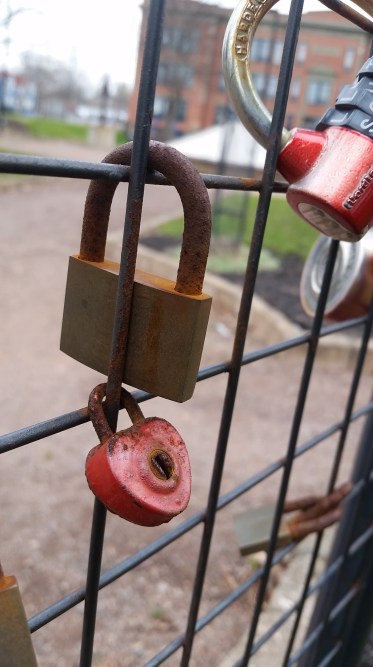
I came across a gate of love locks while haunting the area downtown where I lived in my early twenties. In Europe, love locks are placed on bridges as a symbol of romantic commitment. In Moncton, the plaque stated these locks were a symbol of love for the city’s downtown. Knowing the locals, these locks combine the two meanings together and find their own hybrid vigor somewhere in the smash.

20190504_093534.jpg

2019-05-16 21.22.20.jpg

2019-05-16 21.20.21.jpg

20190504_093456.jpg

There’s an unexpected diversity and creativity hidden in the metal, polish scrubbed away by the elements, rusting patinas standing testament to the salty breezes off the Bay. Maybe Monctonians are a bit like that, too.


Submit Your Stories Sunday: arcane microfiction

Welcome to this week’s edition of Submit Your Stories Sunday! Every week I bring you a unique call for submissions to help you find a home for your stories or inspire a new one. Each call will contain a speculative element and will offer payment upon acceptance. Next, I’ll recommend a story to help inspire your submission and aid new writers in understanding how to best fulfill a call’s thematic elements.

This week we’re looking at the Arcanist‘s open call for microfiction, and reading the drabble Palm Reader by Gwendolyn Kiste as published on the Weretraveler.

rawpixel-315198-unsplash

The Arcanist – Microfiction

Eligibility: science fiction or fantasy stories (horror inclusive) under 100 words. Stories must have a beginning, middle, end, and strong characterization.

Take Note: The Arcanist will be publishing a microfiction story every week on their website, as well as their twitter and instagram accounts.

Payment: $10 USD per accepted story

Submit by: no deadlines, everything open at time of writ. (please check their website in the link below if you’re visiting from the future, you tricky time traveler, you.)

Click here to go to the original call for details.

A Story to Inspire Your Submission:

To get you started, we’ll be reading the 100-word drabble Palm Reader by Gwendolyn Kiste published on The Weretraveler. Click here to go there now. Don’t worry, I’ll be here when you get back.

The reason I chose this drabble is because Palm Reader has a distinct beginning, middle, and end. As we begin the narrator is getting their palm read. We can picture the scene easily without description. We hit the middle as the palm reader squeezes the narrator’s hand, pulling us along in their relationship in a few, brief sentences. They are all we need to know our narrator loves her. The ending arrives and our narrator has been poisoned by their love, thus fulfilling the fortune told in the beginning and bringing the story full circle.

hands black and white fingers palm
Photo by Josie Stephens on Pexels.com

It’s tricky to make your reader care about the characters in such a short piece. This is what the Arcanist wants when they refer to ‘characterization’ – the character should evoke a feeling. It doesn’t have to be positive, but by making the reader feel something, the story will stick with them, no matter how small. We care about the Palm Reader‘s narrator because we know they love this fortune teller, and they still love her despite her murdering of them. That’s a strong, fatal, foolish love. What a loss and tragic end, but they will never awaken to chew on the aftermath, they died in love as ever. It sticks in my mind, frustrating me with its unfairness. Kiste painted this image of character as a function of the plot AND in twenty-five words. The words do double time. Don’t hesitate to use those words.

You know what to do. Good luck!

Happy writing.

third place!

2019-05-07 18.55.20.png

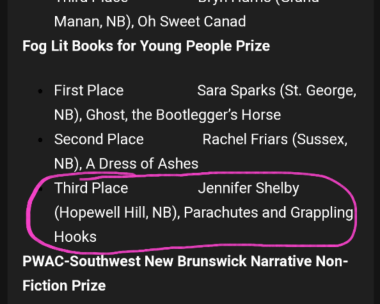
I’m pleased to share that my short story entry won third place in 2019’s Writers Federation of New Brunswick (WFNB) Fog Lit Books for Young People Prize. I won first place in the same competition last year, so it feels good to place again this year and prove to myself it wasn’t a lucky fluke. Last year’s win afforded me the opportunity to read my winning story to an audience for the first time which proved a rich experience for me – one I get to repeat in a few weeks with this new story. The butterflies are already practicing their fluttering in my belly. Eek!

Submit Your Stories Sunday: recognizing fascism

Welcome to this week’s edition of Submit Your Stories Sunday! Every week I bring you a unique call for submissions to help you find a home for your stories or inspire a new one. Each call will contain a speculative element and will offer payment upon acceptance. Next, I’ll recommend a story to help inspire your submission and aid new writers in understanding how to best fulfill a call’s thematic elements.

This week we’re looking at the anthology Recognize Fascism and reading Cyd Athens’ Poison in Fireside Magazine.

rawpixel-315198-unsplash

Recognize Fascism

Eligibility: fantasy and science fiction stories from 250 to 5k words on theme of the first moment a character recognizes fascism and determines to resist.

Take Note: this project will only go ahead if crowdfunding is successful. This is fairly standard for most anthologies and while it does involve some risk, writers should not be deterred from submitting.

What makes this call stand out: with professional payment, there’s a good chance you’ll recognize some of the names in this anthology when it’s finalized. Get in there and submit your story alongside your favorite writers. You never know.

Payment: minimum $0.08 per word.

Submit by: June 3, 2019

Click here to go to the original call for details.

A story to ignite your creativity:

For this week’s inspiration story, I’m stretching the theme a bit to bring you a story that makes you, as reader, the character who first recognizes fascism and resists. You can read or listen to Cyd Athens’ story Poison in Fireside Magazine by clicking here (there is no charge to read/listen to this story but please consider subscribing or buying the issue if you are able).

Poison is written in second person, which gives the reader a deeply immersive experience into the story. In this instance, Athens uses this perspective to reveal the story details like little bombs as you, the reader, awaken to the story reality alongside the character awakening from their poisoned cryo-sleep. Disorientation follows, a strong sense of something isn’t right here and suddenly we’re pushed into an erupting violence and it’s shoot or die, survival instincts screeching as the part of us that’s holding back wondering “Whoa! What is going here?” gets smaller and more subdued as we rescue our fallen friends and race to safety. Once there, Athens pulls back and fills in what we’re missing. Yes, we’ve committed genocide in this story world, we had no choice, we are forced into it by our rulers. The clues were all there, but the confirmation sits awful on us all the same.

This is why I chose Poison to match with the Recognize Fascism call: through Athens’ words, we have just experienced the rising of fascism. We had that moment of sensing something wasn’t right, moving to enormously wrong, and a leap into some future’s mirror to see what horrors we have committed while in a stupor of confusion. An allusion to the dulling and desensitization by relentless media brainwash of dictatorships. These are the elements we need to understand, recognize, and feel to write a story for this Recognize Fascism call. Now we just need to build our stories around them. Good luck.

Happy writing!


IWSG and the power of words

Hello and welcome to the May Day edition of the Insecure Writer’s Support Group (IWSG). On the first Wednesday of every month the IWSG meets to share their goals, insecurities, and writing challenges. If you’d like to join or lurk around to see what’s happening, you can link to the other members here.

iwsg

This month’s optional question is “What was an early experience where you learned that writing had power?” For me it was reading Anne Frank’s The Diary of a Young Girl in grade school. I read this book four or five times between grade five and twelve. Here was a girl my age(s), who faced a tragic end in a concentration camp when the words ran out, mentioned only in the forward and the echo of the empty pages before I reached the back cover. When I read her words, I felt her essence flutter in the pages. This handful of stories written by an adolescent girl taught me more about empathy then I could have experienced in my privileged childhood. I spent hours staring at the ceiling, contemplating how many other Anne Franks died in those camps. She wasn’t just a character or a distant historical figure, she was my friend. That is a formidable power for a small book to have.

#

2019-04-30 19.20.02.jpg
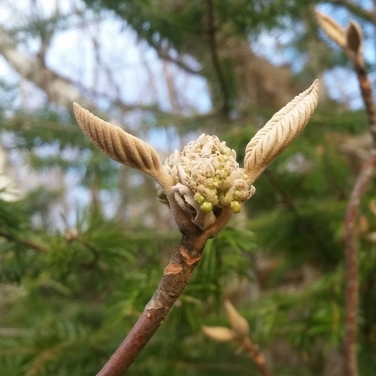
beaked hazel says “hooray for spring!”

April’s been good to me. The Frye (literary) Festival is in full swing in my hometown of Moncton, NB, I became a fox-winning poet, had a short story accepted for Kaleidotrope in 2021, and I received my contributor copies of Unlocking the Magic. Check out this gorgeous cover:

IMG_20190427_195544_146.jpg

My favorite short story writer, A. Merc Rustad (now writing as Merc Fenn Wolfmoor), wrote the story directly before mine in the book, and that makes my imposter syndrome get up and start yelling louder than I’d like. But also… WHAT A THRILL OMG.

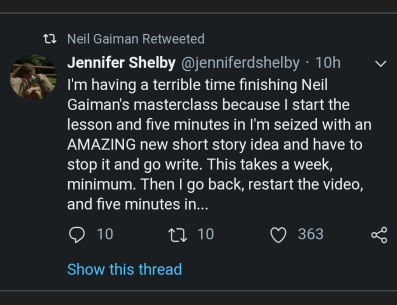
In a twist, my favorite novelist retweeted me a few days ago, which was… unexpected.

2019-04-28 20.50.46.png
that explains all those notifications

See, Neil Gaiman answered a tweet I had tagged him in a few months back, which had a turtling effect on me as an introvert. I put the masterclass away for a few weeks until it felt safe to go back. In writing this new tweet, I didn’t tag him, and so felt comfortable tweeting about how the class was inspiring me. Not shown in the above screenshot is the entire thread, where I finish up by calling Neil a modern-day muse which I meant but probably would never have written had I known he would read it (blush, blush). My inner introvert felt safe with no tags and no hashtags, guessing this tweet would get my usual two or three likes. It was up to 551 this morning. Happily, this time around it didn’t have the same turtling effect on me, though I do think if Mr. Gaiman’s going to keep using my tweets to sell his masterclass he should come over and have spaghetti with my family or something *wink*

I hope April was good to you as well, and I have my fingers crossed that May is going to be gangbusters for all of us insecure writers.

Cheers, and happy writing!


Submit Your Stories Sunday: longevity

Welcome to this week’s edition of Submit Your Stories Sunday! Every week I bring you a unique call for submissions to help you find a home for your stories or inspire a new one. Each call will contain a speculative element and will offer payment upon acceptance. Next, I’ll recommend a story to help inspire your submission.

PLEASE NOTE: there will no Submit Your Stories Sunday next week (April 28th) as I will be attending the Frye Literary Festival in my hometown. The series will resume on Sunday, May 5th, 2019. Thank you!

This week we’re looking into the theme of longevity for a pro-paying anthology and reading Rebecca Lang’s What No One Ever Tells You About Becoming Immortal on DSF.

rawpixel-315198-unsplash

Third Flat Iron Anthologies: Longevity

Eligibility: speculative stories between 1 500 and 3 000 words OR humorous pieces under 600 words, on the theme of longevity.

Take Note: the wording suggests the editors are looking for stories focused on the hows and why of the longevity, rather than just the effects or character living with it.

Payment: $0.06 per word

Submit by: this call is open from July 10th to August 10th, 2019. Lots of time remains to craft up a fresh story.

Click here to go to the original call for details.

A story to ignite your creativity:

To get our imaginations fired to answer this call, we’re going to read Rebecca Lang’s What No One Ever Tells You About Becoming Immortal, published on Daily Science Fiction in 2014. Click here to go read that now.

In this story, Lang uses a steady rise of technology to retain and lengthen lives to an extreme point. It begins with nanotechnology to fix the protagonist’s cancer and later, replace her hip. Medical marvels all, but then the story turns, focusing on the uncomfortable fixation with youth that modern media keeps telling us we have. The marvels shift into vanity, or hubris, and things fall apart for the protagonist. She buys her way out of death, but in so doing loses her self. This story is both a tragedy and a vivid reflection of financial privileged society.

Lang’s story answers the questions Flat Iron poses in their call (how is this life extension possible and what are the side effects) from a Capitalist perspective. What perspective unique to your voice and your favorite genre can you use to write a different set of answers to craft your submission around?

The longevity theme also comes with its own inherent trope. Vampire stories, especially, paint the immortal with endless angst about the perceived tragedy of immortality and outliving family and friends. These stories suggest that if death is cheated, all one finds is regret. We see this echoed in Lang’s story as the protagonist acknowledges that while her body lives, she does not. This trope makes these stories nice and safe for us mortal readers. There, there, gentle reader, you don’t want this immortality you can’t have, just be content with your lot.

Meh. I’ve seen people die of old age. I’m not buying this trope anymore.

So why not blow the trope out of the water? How can you subvert it into something fresh and unexpected? What is it going to take for someone to be happy after thwarting death? Do they need to be a villain, an extreme introvert, or… ? Play with it, see what you come up with. Answer the call to adventure – oops, I mean call for submissions.

Happy writing!
brown wooden desk
Photo by Pixabay on Pexels.com

a poem that won a fox

I am pleased to announce that my writing has won me a fox. There is a shockingly tiny group of fox-winning writers out there. This is definitely going on my CV, right next to ostrich herding and singing lullabies to a sick lion.

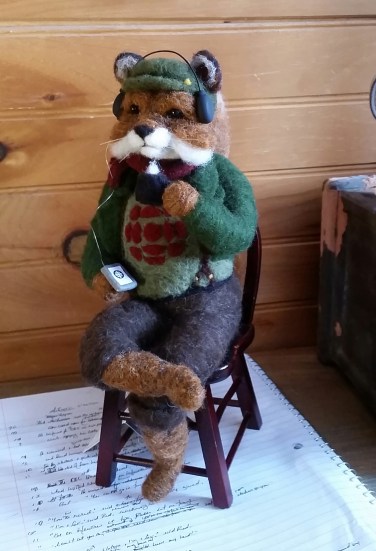
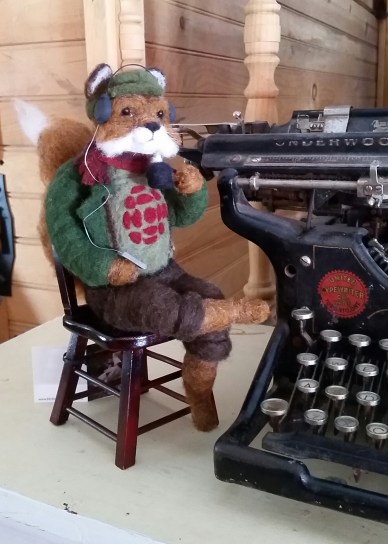
Okay, it’s not a real fox. They belong in the woods. I won a felt fox by fibre artist Bella McBride. Our local CBC’s radio show The Shift held a contest for listeners to write in with a name and a story for the fox. Many of the entries were read on the air (including mine – squee!) and Candace Hare, director of the Nashwaaksis arm of the Fredericton Public Library, was the judge.

I listened to the show last Monday, shoulders tight and nails nibbled. Finally, they announced the winner – and it was me! I got an extra thrill as they discussed the highlights of my entry on air and giggled over all the parts I wanted people to giggle over.

My fox arrived by courier and is now presiding over my writing desk as muse and writing trophy. There isn’t much money in fiction writing, but there are wicked perks where you least expect them.
2019-04-17 16.33.00.jpg

Here’s my entry, which is a light-hearted bit of fun I hope you’ll enjoy reading as much as I did writing it:

Red O’Sullivan, the CBC Fox

Red O’Sullivan was an urban red fox

Who lived near the library in an old cardboard box.

He listened to the CBC on his phone

Sipping coffee and wishing for a show of his own.


Red worried a great deal about climate change

And found human indifference incredibly strange

So he started a podcast to vent his rants

And recorded it from home where he didn’t need pants.


The CBC staff liked his podcast, you see

And invited him over as an interviewee

He arrived on time in his orange fox fur

Only to hear, “You can’t go in there , Mr. Fox, Sir.


You are naked,” said the security guard.


“I’m a fox,” answered Red, nervous and swallowing hard,

“I’ve an interview at two. Please, let me through.”


“I can’t let you in naked. You need clothes, you do.”


“But this is my dream job – the first fox on air!

Is there possibly anything inside I could wear?”


“There’s a green coat and hat in the lost and found,

And this CBC t-shirt’s been lying around.”


They nabbed some suspenders and a pair of pants

From a fan happening by who enjoyed fox’s rants.

A scarf from the guard and his look was complete,

Red the fox went inside to his interview seat.


He answered questions in a confident voice,

Leaving his interviewers no other choice.

He was hired at once to the CBC team,

You can find him there now, he’s living his dream

In a lost and found coat and lovely green hat,

Sipping coffee and hosting a climate change chat.
2019-04-17 16.30.05.jpg

Submit Your Stories Sunday: felines, bicycles, and space

Welcome to this week’s edition of Submit Your Stories Sunday! Every week I bring you a unique call for submissions to help you find a home for your stories or inspire a new one. Each call will contain a speculative element and will offer payment upon acceptance. Next, I’ll recommend a story to help inspire your submission and finish off with a list of writing industry news and articles I came across this week.

This week we’re looking at the Bikes in Space anthology series and reading the Bicycle Rebellion by Laura E. Goodin and published by Daily Science Fiction.

rawpixel-315198-unsplash

Bikes in Space

Eligibility: feminist bicycle fiction on the theme of cats, 500-6K words

Take Note: must be feminist, speculative, and contain kitties

What makes this call stand out: I’ll be honest, it’s the quirkiness that grabs me. I love my bike, I love feminism, and I definitely love my cats.

Payment: dependent upon kickstarter success, but no less than $30 USD per story

Submit by: August 1, 2019

Click here to go to the original call for details.

A story to ignite your creativity:

For the purposes of getting your writing mojo fired up, I’m going to focus on the bicycle aspect of this call rather than the cat or feminism. Those are fairly straightforward, and writing about bicycles always poses the greater challenge for me. The bicycle story we’re going to look at, the Bicycle Rebellion by Laura E. Goodin, does not take place in space, either. What it does do is stretch our imaginations outside of the usual way we think about bicycles, which is what will best help us craft our own stories.

Laura E. Goodin’s the Bicycle Rebellion is available to read for free on Daily Science Fiction. Click here to go there now. I’ll wait.

This story is no wind-in-your-hair love story to the “the beautiful duet of human and machine” (I do love that line of Goodin’s).  The bicycles are not behaving as a bicycle should. They have shed their identity as an inanimate object and rove in “packs of feral bicycles.” This is fresh. It makes me think of both wild animals and those horrific pileups you see on turns in bicycle races. It grabs the reader’s imagination and lets them know the usual rules will not apply in this story. This is the kind of permission we need to give our creative selves when working on a bicycle-in-space story. What can a bicycle do beyond  gravity-required transportation? What can a bicycle be besides a human powered vehicle? We’ve got two wheels, a gear mechanism, some brakes, and the whole universe to work with. Let’s get writing.2019-04-13 15.44.26.png

NOTE: There are multiple Bikes in Space anthologies available. I recommend reading them as they’re fun, imaginative, and the stories are well-written. They will give you the best sense of what the editor likes and what you can do with this theme. However, I couldn’t find them in my local library system and it is important to me to keep this blog inclusive to writers who may not have financial privilege.

Writerly links worth sharing this week:

In a bold move, the Writer’s Guild America East and West advised writers to fire their agents this week. This comes in the wake of distrust caused by agents working for both writers and film companies in negotiation of film rights, which the Writer’s Guild pointed out as a conflict of interest. David Simon detailed his experience of this conflict in an article posted last month.

Happy writing!


Submit Your Stories Sunday: once upon a paranormal romance

Welcome to this week’s edition of Submit Your Stories Sunday! Every week I bring you a unique call for submissions to help you find a home for your stories or inspire a new one. Each call will contain a speculative element and will offer payment upon acceptance. Next, I’ll recommend a story to help inspire your submission and finish off with a list of writing industry news and articles I came across this week.

This week we’re looking at a call for paranormal romance novelettes and reading Deborah Harkness’ book A Discovery of Witches.

rawpixel-315198-unsplash

Once Upon an Enchanted Forest: an Anthology of Romantic Witchcraft Stories

Eligibility: paranormal (witchcraft) romance stories from 7K to 15K on the theme of an enchanted forest. The details in the call strongly suggest the editors prefer the witchcraft element of the story to focus on the magical elements of the Autumn Equinox. Writers are encouraged to look in the lore and history of the Autumn Equinox as research for their story.

Take Note: the editors expect happy or happy-for-now endings

What Makes This Call Stand Out: the terminology suggests the editors are actively seeking out new writers

Payment: $75, 2 paperback copies, and 25 e-copies to distribute. Please note this is a token rate for a novelette.

Submit by: May 15th, 2019

Click here to go to the original call for details.

A story to ignite your creativity:

While I usually try to find a free-to-read short story for Sundays, in this case I’m recommending Deborah Harkness’ A Discovery of Witches, the first book in the All Souls trilogy. Disclaimer: I haven’t seen the television series and my opinions reside solely on the books. The protagonist of the story, Diana Bishop, is a spellbound witch and Oxford scholar who finds herself entangled with chemist/vampire Matthew Clairmont when she calls up a enchanted book in the Bodleian library. Love, intrigue, and time travel soon follow. As it often does.20190406_123615.jpg

What I like about this book for Once Upon an Enchanted Forest‘s call is the looming darkness that begins in A Discovery of Witches as demons gather around the book and Diana discovers her magical abilities. The mood is right. If the witchcraft is removed from the story, it will fall apart.

Most of the magical elements of A Discovery fall under the ‘common knowledge’ umbrella.  Here’s where I’d encourage you, as a writer, to do a little research into the Autumn Equinox of pagan religions. Harkness has several original elements in the novel, so she can get away with common magical tropes. You aren’t likely to get away with that for the Enchanted Forest call. There is fascinating lore to Mabon (the Autumnal Equinox), and finding something unexpected and unusual to build into your story will give you an edge. How do cultures outside of the western hemisphere celebrate the harvest and shorter days with longer nights?

The intrigue of A Discovery of Witches is rich and tangled, matching the request of the Enchanted Forest’s editors. A novelette will have less room to build this intrigue than a trilogy, obviously, and that is where depth and focus must take over. Plot heavily and weave in the intrigue with stealthy fingers. Just make sure its there.

Writerly links worth sharing this week:

The Hugo award nominations are up! You can read them all here.

In this article, Arkady Martine suggests that every writer gets one free talent and we can use that to build on the talents we don’t have naturally.. What do you think? What’s yours? Disclaimer: I have no idea what mine would be.

Happy writing!